

It’s been two years since I stumbled into a Barnes & Noble and bought this book as a gift for myself. I was feeling down—a little gray, a little out of it. But I knew that a new, freshly printed novel would help heal me.
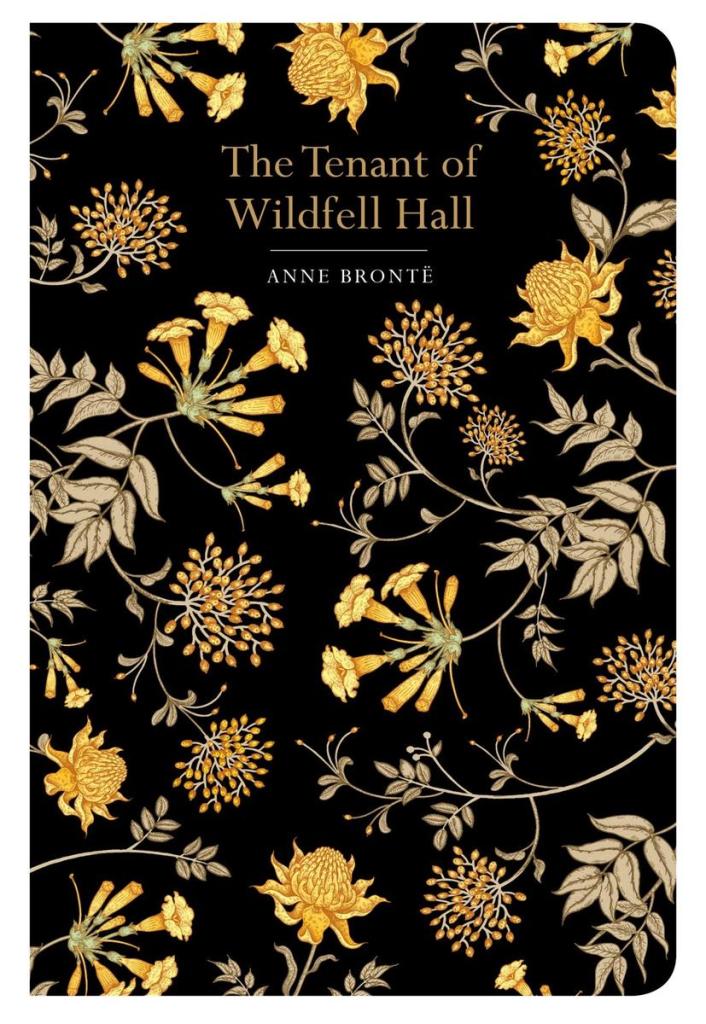
This book caught my eye because it had embossed flowers on the cover. They were dainty and yellow, and contrasted with the black background. Maybe I related to the flowers. Whatever it was, this book by Anne Brontë soon made its way into my shopping bag.
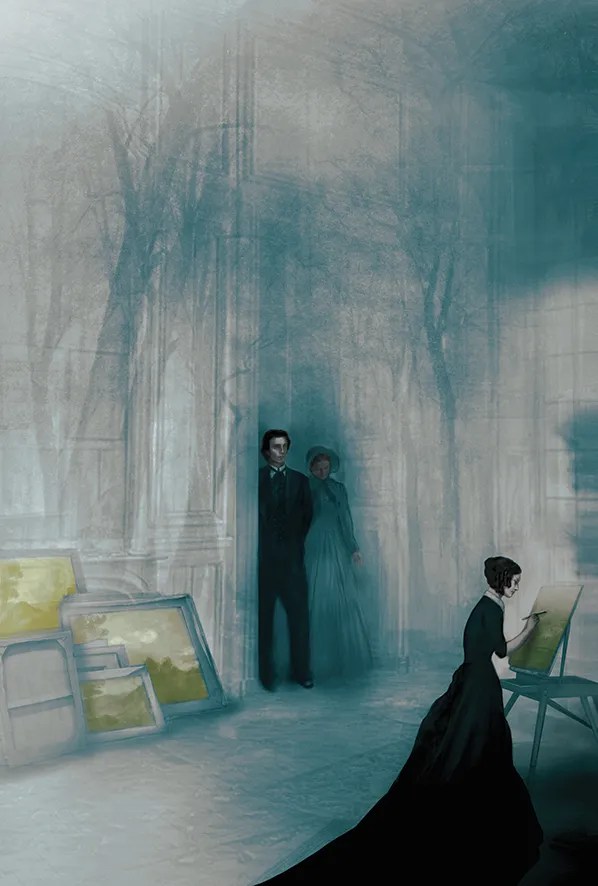
Valentina Catto for The Folio Society’s edition of Anne Brontë’s The Tenant of Wildfell Hall
The Awakening
In our youth, we are often asleep. I wanted to believe that everyone around me was a friendly character in my dreams. I was so blissfully unaware of the monsters under the bed, those whose only dreams were to make the lives of others into living nightmares.
This book is slow and sad, but I feel that all Brontë novels are like that. Somewhere around Chapter 5 or 10, you lose yourself and suddenly have a new favorite book.
I began noticing that the character was thinking and saying things . . . that I’d thought and said. It made me uncomfortable. It made me wary. I thought of how God, in His wisdom, would know that one of the only thing that could get to me was a story.
The Point
The Tenant of Wildfell Hall is the story of a woman who marries a cruel man and who, to have a better life and hopefully keep her young son from becoming like him, moves away to a safe haven where she can paint and raise her son in peace.
I’d like to share some of my favorite quotes—perhaps they will convince you to read this masterpiece.
His heart was like a sensitive plant, that opens for a moment in the sunshine, but curls up and shrinks into itself at the slightest touch of the finger, or the lightest breath of wind. This could be the lyrics of a modern-day heartbreak pop song.
TIMELESS dating advice: When I tell you not to marry without love, I do not advise you to marry for love alone: there are many, many other things to be considered. Keep both heart and hand in your own possession, till you see good reason to part with them; and if such an occasion should never present itself, comfort your mind with this reflection, that though in single life your joys may not be very many, your sorrows, at least. Keep a guard over your eyes and ears as the inlets of your heart, and over your lips as the outlet, lest they betray you in a moment of unwariness. Receive, coldly and dispassionately, every attention, till you have ascertained and duly considered the worth of the aspirant; and let your affections be consequent upon approbation alone. First study; then approve; then love. Let your eyes be blind to all external attractions, your ears deaf to all the fascinations of flattery and light discourse. – These are nothing – and worse than nothing – snares and wiles of the tempter, to lure the thoughtless to their own destruction. Principle is the first thing, after all; and next to that, good sense, respectability, and moderate wealth. If you should marry the handsomest, and most accomplished and superficially agreeable man in the world, you little know the misery that would overwhelm you if, after all, you should find him to be a worthless reprobate, or even an impracticable fool.ill not be more than you can bear. Marriage may change your circumstances for the better, but, in my private opinion, it is far more likely to produce a contrary result.
These quotes are about the main character’s husband, which I found very fascinating.
He is very fond of me, almost too fond. I could do with less caressing and more rationality. I should like to be less of a pet and more of a friend, if I might choose; but I won’t complain of that: I am only afraid his affection loses in depth where it gains in ardour. I sometimes liken it to a fire of dry twigs and branches compared with one of solid coal, very bright and hot; but if it should burn itself out and leave nothing but ashes behind. Women do not wish to be pets—kept in a cage, tossed a fancy collar or treat every now and then. And, secondly, good love is constant, secure.
If I hate the sins, I love the sinner, and would do much for his salvation. This is literally like the words to Taylor Swift’s song: “I would’ve died for your sins, instead I just died inside…”
And, finally . . . too often, we want to fix people. I believe its our natural nurturing nature, but misplaced when we focus the effort on already-grown, already-bent, already-hopeless people.
In the following passage, a young Helen is being interrogated about why she loves such an unruly man.
“What is it that constitutes virtue, Mrs. Graham? Is it the circumstance of being able and willing to resist temptation; or that of having no temptations to resist? – Is he a strong man that overcomes great obstacles and performs surprising achievements, though by dint of great muscular exertion, and at the risk of some subsequent fatigue, or he that sits in his chair all day, with nothing to do more laborious than stirring the fire, and carrying his food to his mouth? If you would have your son to walk honourably through the world, you must not attempt to clear the stones from his path, but teach him to walk firmly over them – not insist upon leading him by the hand, but let him learn to go alone.’
‘I will lead him by the hand, Mr. Markham, till he has strength to go alone; and I will clear as many stones from his path as I can, and teach him to avoid the rest – or walk firmly over them, as you say; – for when I have done my utmost, in the way of clearance, there will still be plenty left to exercise all the agility, steadiness, and circumspection he will ever have. – It is all very well to talk about noble resistance, and trials of virtue; but for fifty – or five hundred men that have yielded to temptation, show me one that has had virtue to resist. And why should I take it for granted that my son will be one in a thousand? – and not rather prepare for the worst, and suppose he will be like his – like the rest of mankind, unless I take care to prevent it?”
The Vibes
- A mysterious house
- Moody moors (as always, is it a Bronte novel without it?)
- Painting
- Mistakes, and living with them
- Lies & treachery
- Timeless dating advice
The Confession
I read most of this book, but to be honest, I never finished. I was shocked and bewildered and astonished by the words that though written so long ago mirrored my own situation; I saw ahead of me a future I did not want. So, before I could get to the end of Helen’s story, I decided to finish my own chapter.
I would not become Helen. And, I hope, neither will you. ❤
 Wallflower Garden
Leave a comment