

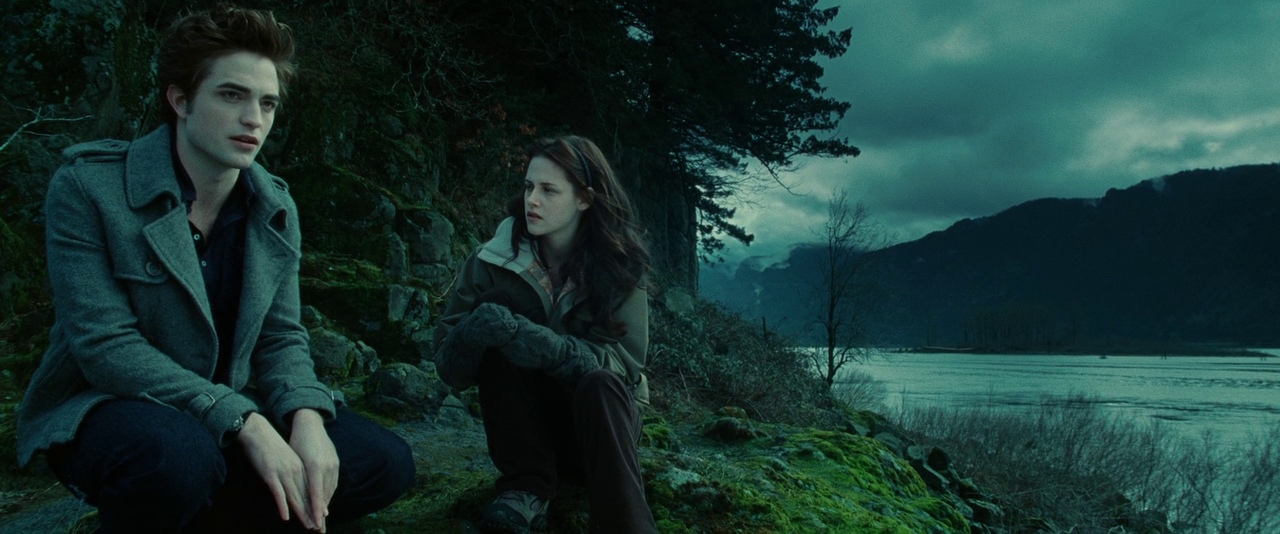

The year is 2015. I’m watching Twilight for the first time. And my life is changed forever.
Maybe it was the moody blue color grading. Maybe it was Edward’s gray pea coat or the magically mossy PNW forests.
But at the time, I credited that feeling to the strong desire to one day be in a relationship just like Bella and Edward’s. Where “no one else understands us,” and he warns me how protective he feels of me, and he tells me that “no one will believe you” with a smirk in the halls of a hospital.
Yeah — it’s obvious now that our brains are fully developed (doesn’t happen until the age of 26, by the way) and we’ve been through a couple questionable relationships.
But when people whose brains aren’t developed are reading these YA novels, it’s no surprise that they end up hard encoding these romantic relationships into their psyche as The Peak Romantic Relationship.
We build our own cages.
I’m making a promise to you today: no book I ever write will romanticize abusive relationships. If the people are unhealthy, they’ll acknowledge their shortcomings and grow, or else leave the picture entirely to heal on their own.
I was shook when I first read A Ballad of Songbirds and Snakes (in a good way): it was the first time I’d seen a girl in YA break up with The Bad Boy. As I watched Coriolanus descend into darkness, my heart hitched for Lucy Gray.

I’d seen this film before —
And I didn’t like the ending.
The manic pixie dream girl, with her positivity and rainbow skirts and music, tries desperately to fix the dark-yet-misunderstood MC. And the problem is, in a lot of fiction, it seems to work. The guy does change. The girl does get to be the savior. And you better believe that teenage me internalized that message.
“Only an act of true love can melt a frozen heart.” — Bad advice from Frozen
It didn’t help that my favorite Disney princess growing up was Belle (OH NO). I admired her for not judging a book by its cover: for seeing past the beast, to the prince hidden underneath.
But sometimes, there is no prince.
“He is controlling” is instead described as protective. “He is volatile” is turned into darkly intense, romantically passionate even.
Someone warning that “You shouldn’t be with me, I’m dangerous” (paraphrasing Twilight here, of course…but also personal experience) becomes an open invitation to grab your toolbox and FIX HIM.
And if he doesn’t change?
You haven’t tried hard enough. You haven’t smiled enough, forgiven enough, seen past the cover enough.
No one else understands him the way that you do.
There’s good news: Lucy Gray set her toolbox down.
SHE. GOT. AWAY.

The story leaves it up to you to decide what happened, but I like to believe that she recognized that Coriolanus Snow had always been a simmering narcissist and ran away before he could take her down with him — or, even, murder her.
Because that’s the thing that made me shiver while watching the movie and say Yes, THIS.
People can easily be charming when you like them and they’re getting their way. You see this in Coriolanus. At first, alone in the forest, he begs Lucy Gray to come back. He is gentle, pleading. His eyes sad.
But, once he assumes she left a snake in his mother’s scarf and translates this as betrayal, the mask slips. Foaming, feral rage consumes him. He’s screaming into the forest, firing machine-gun style into the foliage.
And he wanted to keep her. Safe and close at hand. Admired and admiring. Devoted. And entirely, unequivocally his.
Healthy love doesn’t transform into terror the moment someone says no. And Lucy Gray didn’t wait to see the mask slip.
Unfortunately, a lot of the stories I read growing up (specifically YA) didn’t show this step. And I would love to see this experience represented more in fiction, because it warns the young reader that sometimes you must run.
And if we begin to pump out fiction that gives women permission to be safe, love people that love them back, and name abuse?
Maybe we, and our friends and sisters and daughters, don’t have to become another statistic.
I’m hoping to make a small ripple in a very large lake with the romantic relationships represented in the books I write. Because, yes, we know it’s fiction. But we are the sum of the people closest to us; and, similarly, we are the sum of the stories that find their way into our hearts and minds long after we’ve set them down.
Leave a Reply